
Free Printable Sight Word Bingo Cards for Kindergarten to 3rd Grade
Improve reading skills with our customizable Sight Word Bingo generator. It uses Dolch and Fry high-frequency words, making it a great addition to structured literacy and Orton-Gillingham lessons.
- Grammar
- Phonics
- Reading
- Sight Word
- Vocabulary
You are browsing category Sight Word show all

1-50 Fry Sight Word Bingo
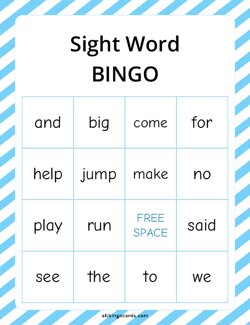
Grade 1 Sight Word Bingo
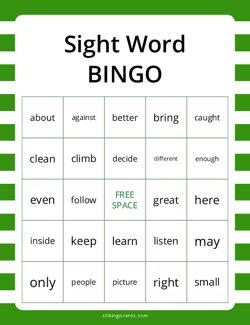
Grade 3 Sight Word Bingo
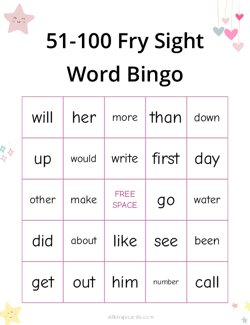
51-100 Fry Sight Word Bingo
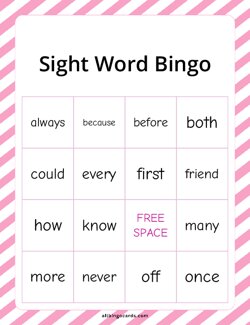
Grade 2 Sight Word Bingo
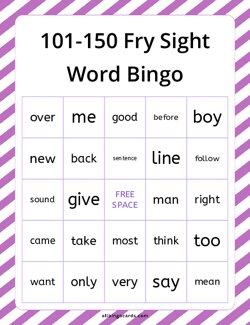
101-150 Fry Sight Word Bingo
Q: What are Sight words?
A: Sight words, also known as high-frequency words, are words that show up most often in English, like the, and, it, and she. They are called sight words because children should be able to recognize them right away, without having to sound them out. Many sight words do not follow regular spelling rules, such as was or who, which can make them hard for early readers to figure out.
Q: What is the difference between Dolch and Fry Sight Words?
A: Both lists highlight high-frequency words, but they come from different backgrounds and cover different ranges.
- The Dolch List: This list was made in the 1930s by Dr. Edward William Dolch. It has 220 common "service words" and 95 nouns that frequently appear in children's books. The list is usually split by grade level, from Pre-K to 3rd Grade.
- The Fry List: Created by Dr. Edward Fry in the 1950s and updated in the 1980s, this list is larger, with 1,000 of the most common English words, ranked by how often they appear. The first 100 words make up about half of all written text.
Q: Which should you use for Bingo?
Q: What is the best way to teach sight words using Bingo?
A: The most effective method is "See, Say, Mark." When the caller identifies a word, students find it on their card, say it aloud to a partner, and mark it. This reinforces visual recognition, auditory processing, and verbalization together.
Q: Are these cards based on the Dolch or Fry word lists?
A: Our generator is compatible with both! You can select pre-made lists for Dolch (Pre-K through 3rd Grade) or Fry’s High-Frequency Lists (1-1000). You can also mix and match by pasting your own custom curriculum list into our editor.
Q: How many unique cards can I generate for my class?
A: For a standard classroom, we recommend printing 25 to 30 versions so students do not all reach "Bingo" at the same time. This keeps the game competitive and engaging.
Q: Can I play Sight Word Bingo virtually?
A: While our cards are optimized for printing, you can save them as a PDF and share your screen during a Zoom or Google Meet session. Students can use digital annotation tools to mark their squares on their devices.
How to play:
- Call out a sight word.
- Kids look for it on their cards.
- If they find it, they cover the word.
- The first one to cover a row, column, or diagonal shouts, "Bingo!"
These bingo cards are perfect for teachers, parents, and homeschoolers. Use them in classrooms, at home, or during playdates. Learning sight words has never been so fun!
